REVIEW ARCHIVE
Welcome to my thoughts where there is only me and my opinions.
looking for
Everything is Tuberculosis
[2025] [Nonfiction]
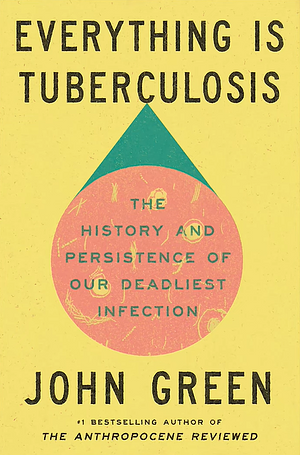
[John Green]
[FORMAT: Digital]
[STATUS: FINISHED]
SYNOPSIS
Tuberculosis has been entwined with humanity for millennia. Once romanticized as a malady of poets, today tuberculosis is a disease of poverty that walks the trails of injustice and inequity we blazed for it.
In 2019, John Green met Henry, a young tuberculosis patient at Lakka Government Hospital in Sierra Leone while traveling with Partners in Health. John became fast friends with Henry, a boy with spindly legs and a big, goofy smile. In the years since that first visit to Lakka, Green has become a vocal and dynamic advocate for increased access to treatment and wider awareness of the healthcare inequities that allow this curable, treatable infectious disease to also be the deadliest, killing 1.5 million people every year.
In Everything is Tuberculosis, John tells Henry’s story, woven through with the scientific and social histories of how tuberculosis has shaped our world and how our choices will shape the future of tuberculosis.
FAVORITE QUOTE / MOMENT
"And this is why I would submit that TB in the twenty-first century is not really caused by a bacteria that we know how to kill. TB in the twenty-first century is really caused by those social determinants of health, which at their core are about human-built systems for extracting and allocating resources. The real cause of contemporary tuberculosis is, for lack of a better term, us."
MY FULL REVIEW
I've had this book on my TBR for a long time; John Green's writing has a soft spot in my heart. I grew up reading his young adult books, and while I haven't read his works in years, I've heard his nonfiction is good. So, after putting it off for a long time, I finally read Everything Is Tuberculosis.
Tuberculosis is a sensitive topic for me; my grandma died because of it. As I've said before in others of my writings, my country is a developing one. We have a lot o struggles with health and food, and all of this was way worse in the '70s—we were at war, we had a military government, and the people were impoverished. My family was never poor, but neither were they well-off. They had a house that they owned, my granddad had a government position, my great-grandma was a merchant, and my grandma was a stay-at-home wife. My mum was the fourth of five children, and living in that turbulent political and social ambient was a struggle.
My grandma got sick when my mum was 5, and she died when my mum turned 7. She spent 2 years sick without being able to access medication or go to a sanatorium (we had an excellent one; even foreigners came to heal there). They just couldn't afford it, and since there was a war, a lot of the public health resources were used for the army instead of the people.
Green took a very socially conscious approach to it. The phrase "tuberculosis is not where the cure is, and the cure is not where tuberculosis is" stuck with me. Living in a developing nation is a constant reminder that we are seen as second- or third-class human beings. We are not important as humans; only our resources are important if they can be extracted. I have seen people die of diseases that have a cure, but it's not accessible to them.
Even with all of this, I'm still in a privileged position: I have a university degree, I have a job that gives me flexible hours, I don't have any children, and both my parents work in the medical field, so we have easy access to medicine or healthcare. Many women my age don't have this privilege. Many have left school to raise their children (even when they were 12, 13, 14, or 15), many queue for 2 or 3 hours to get medicine, and even more don't have access to it at all—and none of this is ever addressed in any candidate's speech for a government position. Green's words hit me hard in the sense that I have been taking my healthcare privilege for granted. I've forgotten that not everyone is able to access it as easily as I can, and with that, I've forgotten my grandma's story.
It's still insane to me how much tuberculosis has shaped our history, and Green really makes it easy to understand. I also really, really, really liked Henry's story and how easy it is to forget us folks from developing nations, but I also appreciated Dr. Girum's effort to get Henry the treatment he needs.
I want to place a big emphasis on Dr. Hart, a trans man who used X-rays to diagnose TB around the US. A lot of people tend to say that LGBT+ people are "a new phenomenon," but we're really not. We have always existed; we just had to hide to survive.
Overall, I think John does an excellent job of weaving the history of TB with his personal experiences and with different people's stories of it. I think it's a good book for getting started if you want to learn about TB.
RATING: ★★★★☆ (4.75/5)
📷
AESTHETICS / SCREENCAPS