REVIEW 09
Welcome to my thoughts where there is only me and my opinions.
Entangled Life: How Fungi Make Our Worlds, Change Our Minds and Shape Our Futures
[2020] [nonfiction/nature]
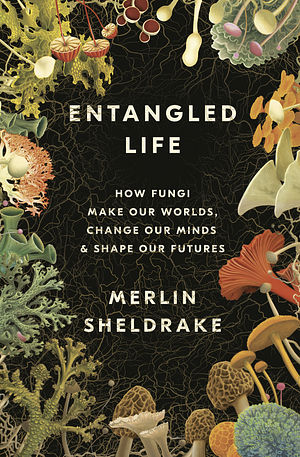
When we think of fungi, we likely think of mushrooms. But mushrooms are only fruiting bodies, analogous to apples on a tree. Most fungi live out of sight, yet make up a massively diverse kingdom of organisms that supports and sustains nearly all living systems. Fungi provide a key to understanding the planet on which we live, and the ways we think, feel, and behave. In Entangled Life, the brilliant young biologist Merlin Sheldrake shows us the world from a fungal point of view, providing an exhilarating change of perspective. Sheldrake’s vivid exploration takes us from yeast to psychedelics, to the fungi that range for miles underground and are the largest organisms on the planet, to those that link plants together in complex networks known as the “Wood Wide Web,” to those that infiltrate and manipulate insect bodies with devastating precision. Fungi throw our concepts of individuality and even intelligence into question. They are metabolic masters, earth makers, and key players in most of life’s processes. They can change our minds, heal our bodies, and even help us remediate environmental disaster. By examining fungi on their own terms, Sheldrake reveals how these extraordinary organisms—and our relationships with them—are changing our understanding of how life works.
"Fungi make worlds. They also unmake them. There are lots of ways to catch them in the act. When you cook mushroom soup, or just eat it. When you go out gathering mushrooms, or buy them. When you ferment alcohol, plant a plant, or just bury your hands in the soil; and whether you let a fungus into your mind, or marvel at the way that it might enter the mind of another. Whether you’re cured by a fungus, or watch it cure someone else; whether you build your home from fungi, or start growing mushrooms in your home, fungi will catch you in the act. If you’re alive, they already have."
I've always loved nonfiction books, I was that kid reading dictionaries and encyclopedias like crazy, at the beginning of the year I read braiding sweetgrass by Robin Wall Kimmerer, it left such a deep impresion on me that I my mission this year to read ecology books more frequently. Also I love fungi, I live near a forest (like, right next to it) so during the rainy season I go and look for mushrooms (just to take pictures I'm nos smart enough to know which are safe to eat). So, Entangled life came like a very natural (ha) pick.
Before I go on about fungi I have to explain something, I HATED back in my biology class when the other students didn't take seriously the fungi kingdom, and they said they were just plants (the autism in me was showing because they were throwing incorrect facts about a topic a was passionate about). So the fungi kingdom has a very special place in my heart.
Sheldrake is a mycologist, and he (just like me) loves to explain that fungi are not plants, actually they are more closely related to animals, and that alone breaks the assumptions we have about what counts as “life.” Most fungi are also not mushrooms. The mushroom is only the fruiting body, the apple on the tree, as Sheldrake puts it. The organism itself is the mycelium, a network of filaments running through soil, rock, and living and dead bodies. These networks can be miles wide and thousands of years old.
The most amazing part is that they can learn. Scientists have shown that mycelial networks store information and change their behaviour based on past experience. If a food source is removed and the connections are cut, new filaments still grow in the right direction. Sheldrake admits it is hard not to call this memory. Fungi also make the world we live in. They turned rock into soil and allowed plants to leave the water and colonize land, and about 90% of plants depend on them for minerals. Without fungi there is no forest and no grassland.
Fungi blur every boundary we use to sort life into categories. Lichens are fungi plus algae. Mycorrhizae are fungi entangled with plant roots. Yeast has been tied to human history through bread, wine, and beer for thousands of years. Sheldrake quotes the line “we are all lichens” and means it literally: there are no true individuals, only systems that matter keeps passing through. A body is not a closed thing but a process, a temporary gathering of matter. That idea takes apart the picture of the isolated, self-contained individual that so much of Western thought is built on.
I really liked the tone of the book, I really don't mind dry reads (I do research as a hobby, I love reading dry ass papers from seventy years ago), but I really appreciate when scientist are allowed to write with excitement about their field, I think this kind of tone it's what helps people get into science. Also, he is careful. He separates what is still debated, such as how information actually moves through mycorrhizal networks, from what is well supported, which I appreciated because I wanted to trust the science and not just be dazzled by it.
The book also has a practical and hopeful side. Fungi can digest crude oil, plastics, and TNT, and they can be used for sustainable building materials and leather. They can help clean up environmental disasters (RADIATION). There is this chapter on psilocybin, it is historically rich, but it takes up a lot of space compared to the other applications, and a reader who does not care about altered states may find it too long (not me tho). But it's s also where Sheldrake is most daring, a thing we don't really see on many books, asking what it means that a fungus can change how a human mind works, and who is really in charge of that relationship.
I think if you are used to reading academic papers or science reports you'll have fun, but if you are a casual reader you may find it kind of heavy, like the writing is accessible, but the book is dense, and (in my opinion) it is best read in pieces in this case. I read a review calling it “challenging but strangely inspiring, humbling, and definitely mind-boggling”. It made me want to go outside and dig in the dirt, which I think all scientific divulgation books should inspire
So give it a read, I assume you want to know about the wood wide web (heh) or you want your idea of what is alive and what is intelligent turned upside down, read it. It shows how much of the world we walk past without seeing. And as Sheldrake says, fungi have already caught you in the act of being alive.


